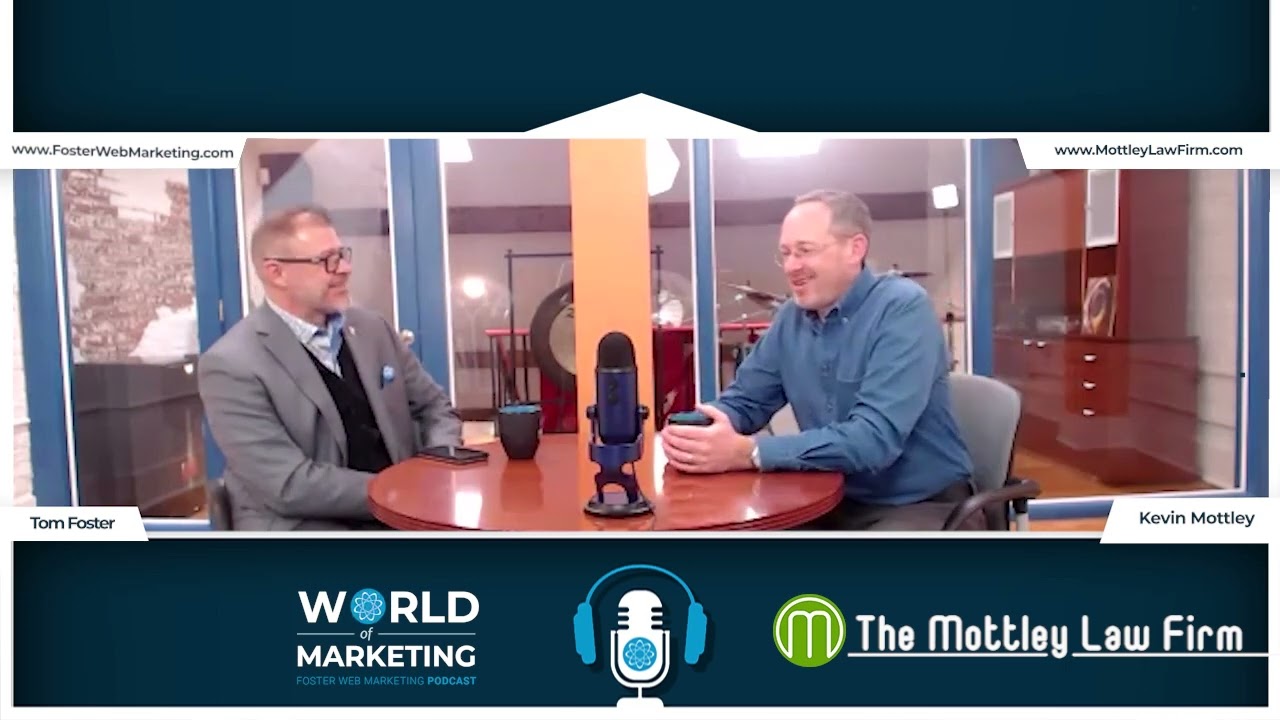
Richmond attorney Kevin Mottley founded his Richmond-based personal injury firm in 2009 with a website that looked like most law firm sites of the era — a digital brochure. His name, his practice areas, and a phone number. That was about it.
By the time he met Tom Foster at a legal marketing event in 2012, Kevin already sensed something needed to change. He just wasn't sure what.
"Tom seemed very knowledgeable about all things website-related — not to mention marketing in general,” Kevin said. “He helped me come to my senses.”
Kevin joined Foster Consulting™ as a client in 2013. The early years were a learning curve. He handled his own content and freely admits the results reflected that. Traction came slowly. But as he handed more of the content strategy over to the Foster team — and sharpened the firm's focus on traumatic brain injury cases — things began to click.
Then came the next wave of disruption.
Table of Contents
The Question That Changed Everything
The clearest sign of the shift came from the simplest question Kevin's intake team asks every new client: how did you find us?
"More and more are telling me that they found me using AI," he said.
This wasn't a trickle. Starting in late 2024 and accelerating through 2025 and into 2026, a recognizable pattern emerged. A father whose child was injured by a defective product. A mother whose 15-month-old daughter suffered a brain injury in a car crash. They found Kevin not through a Google search or a paid ad — but through an AI assistant.
"If you're not showing up in those recommendations from AI, you're invisible," Kevin said. "I've put a real premium on making sure that when somebody searches for a topic, I'm being suggested by AI as a resource."
That premium has paid off. When Foster's team ran independent tests across Perplexity, ChatGPT, and Claude, Kevin's name came up repeatedly — not because he paid to be there, but because the depth and authority of his online presence had earned him a spot.
What It Actually Takes to Show Up in AI Search
 Kevin's strategist, John Spare, has been watching the AI search shift closely — and moving to get ahead of it before most firms noticed it was happening.
When Google's AI Overviews began pushing traditional organic results down the page, John started reverse-engineering how certain firms were getting pulled into those featured responses. The answer came down to two things working together: a technically sound, well-optimized site, and content with genuine, demonstrable authority.
That means consistent citations across every directory, a clear and established domain history, and structural elements — like schema markup and jump-link tables of contents on substantive pages — that make it easier for AI systems to parse and cite the content.
Today, queries like "best TBI attorney in Richmond," "brain trauma attorney", "TBI and cerebral palsy", "what happens when you crack your skull", and "depressed skull fractures" now return The Mottley Law Firm at position one in Google's AI Overview. And that's not a static achievement — each month, John tracks new keywords climbing into first-position AI placements to demonstrate how Kevin's authority continues to grow. "It's like checking the scoreboard of a baseball game," he said.
But John is also clear about why Kevin's results are especially strong: ongoing optimization is the accelerant, not the foundation. Kevin's site is large, well-built, and filled with years of specific content on brain injuries. He has published videos demonstrating his expertise in real time. He maintains a section of his site written for other attorneys interested in referring brain injury cases — a signal of peer authority that AI systems are designed to recognize.
That combination of deep niche content and technical structure is what made the AI search breakthrough possible. Neither element works nearly as well without the other.
The Results, in Plain Terms
 In the first half of 2026 alone, The Mottley Law Firm saw goal conversions jump more than 77% year-over-year compared to the same period in 2025. Leads tripled over that same window. Google Ads conversions came in at a fraction of the industry-average cost per conversion.
Organic search remains the firm's strongest channel — a sign that years of consistent, high-quality content have compounded into real authority. And clients arriving through AI referrals differ from those arriving through traditional search traffic. They didn't click on an ad. They asked an AI assistant who the right attorney was for their situation — and they got Kevin's name. By the time they call, the decision is largely already made.
Why Attitude Is a Competitive Advantage Right Now
Kevin is quick to acknowledge that AI's rise in search has made some lawyers anxious. He's sat in those conversations.
"I'm not intimidated by it. I'm excited about it," he said. "Once I start figuring out how it works, it's like firecrackers going off in my head — all the things we could do."
That openness isn't blind optimism. It's a strategic posture. Kevin's philosophy is simple: whatever form AI search takes, his goal stays the same — to be the attorney AI recommends when someone needs help. Zero-click results, conversational answers, traditional blue links — he's not attached to the format. He's attached to being found.
He extends that excitement internally as well. Kevin is building an AI-powered database of every personal injury case he has ever settled — pulling in variables like insurance coverage, injury severity, and case specifics — to develop a smarter framework for valuing new matters. He's using AI to surface potential biases in his own case assessments and sharpen his instincts.
The technology isn't a threat to his expertise. It's a tool that makes his expertise go further.
"Whatever it turns out to be, how it works — I think AI's desire is going to be to match consumers with the right fit," Kevin said. "And as long as that's the case, I'm fine with that."
What Kevin's Results Mean for Other Attorneys
Kevin's path from brochure website to AI-recommended authority reflects a set of principles any firm can apply.
1. Years of Real Work Are What AI Rewards
Kevin didn't appear in AI recommendations because he gamed a system. He appeared because he spent over a decade building a genuinely authoritative online presence — deep, specific content on traumatic brain injury, a large and technically sound site, consistent mentions across the web, and a reputation that extended to peer attorneys. AI systems are built to surface real expertise. The most important thing any firm can do is make sure its is visible.
2. Structure Is What Makes Authority Discoverable
Even a site with excellent content can be invisible to AI if it isn't built to be easily parsed. Schema markup, clear heading hierarchies, and jump-link tables of contents are no longer optional extras. They're the infrastructure that determines whether AI systems can find, understand, and cite what's on the page.
3. Niche Authority Beats General Visibility
Kevin's results are strong not because he covers everything, but because he has built a reputation as a focused authority on traumatic brain injury. AI systems look for the most credible, specific source for a given query. A firm that has written deeply and consistently about one area of law will almost always outperform a generalist when a user asks a targeted question.
4. The Right Partner Keeps You Ahead of the Curve
Kevin didn't figure out Answer Engine Optimization on his own. John was already reverse-engineering AI Overviews, testing structural changes, and tracking keyword movements before most firms had noticed the problem existed. That proactive, data-driven approach — treating a client's rankings like a scoreboard — is what separates practices that lead from practices that react.
The Clock Is Already Running
The attorneys who show up in AI recommendations today didn't get there last week. They got there because they started years ago — writing the right content, building the right structure, earning the right signals — before anyone was calling it AEO.
The window to build that kind of authority isn't closing. But it is compressing. Every month that passes is a month a competitor's content ages into credibility while yours stays where it is.
Kevin Mottley didn't wait until AI search felt urgent. He was already there when it arrived.
Where does your firm stand right now? A Foster Answer Engine Audit shows you exactly how AI-driven search engines currently interpret your site — and what it would take to become the attorney they recommend.